Physicly
How to Track Muscle Growth: Lifts, Tape and Photos
A training log, a tape measure and progress photos each miss something. How to track all three per muscle group and read them together to see real growth.
Quick answer
Track muscle growth with three signals on a fixed schedule: a training log (weight and reps on the same lifts), tape measurements at the same sites with your waist as a control, and progress photos in one repeatable setup. Read them together every 4 to 8 weeks, because each one alone is easily fooled by skill, fat or water.
Key takeaways
- No single home measurement shows muscle growth reliably; a training log, a tape measure and photos each catch what the others miss.
- Strength can rise without visible growth, especially in the first weeks of a new lift, so a log alone overstates progress.
- A limb measurement only means muscle when your waist holds steady; if both grow, part of the gain is fat.
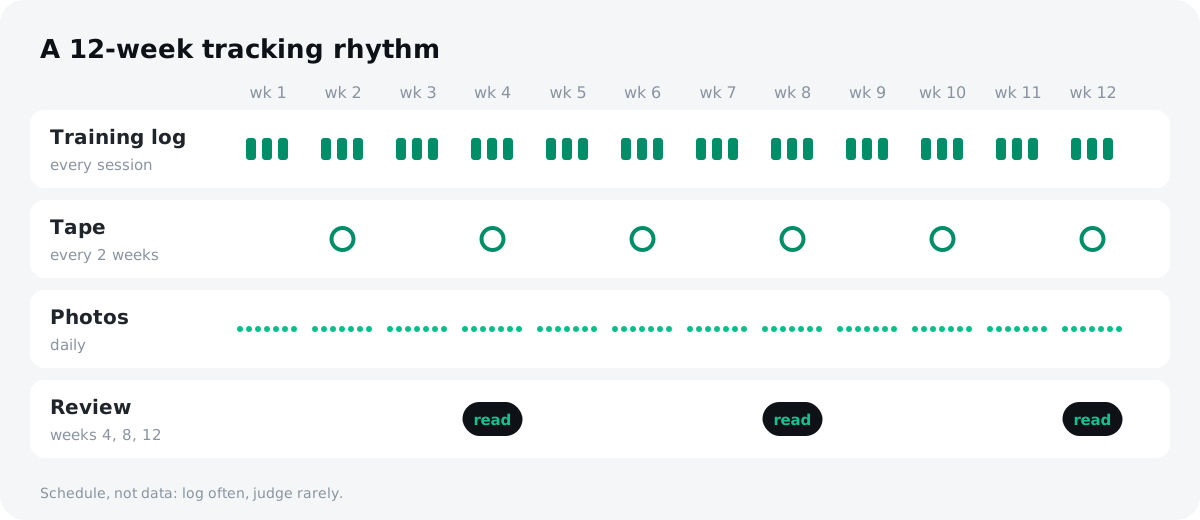
- Log every session, measure every two weeks, photograph daily, and judge all three together at weeks 4, 8 and 12.
- Tracking per muscle group shows which parts of a program work and which lag, which a whole-body number cannot.
Your bench press is up 15 lb since the summer, the scale barely moved, and the mirror looks about the same. Did you build muscle or not? No single number you can take at home answers that. A training log, a tape measure and progress photos each see part of the picture and each can be fooled. This guide shows how to track all three, muscle group by muscle group, and how to read them together so you know what actually changed.
What is the best way to track muscle growth at home?
The most reliable home method is three signals checked on a fixed schedule: performance in a training log, girth with a tape measure, and shape in progress photos. Each one has a blind spot, and the blind spots don't overlap much, so agreement between them is what counts.
| Signal | What it shows | How often to record | When to judge it | What fools it |
|---|---|---|---|---|
| Training log | Weight and reps on the same lifts | Every session | Every 2–4 weeks | Better technique, fatigue, a bad night's sleep |
| Tape measure | Girth at one site | Every 2 weeks | Every 4 weeks | Fat gain or loss, pump, tape placement |
| Progress photos | Shape and proportions | Daily or weekly | Every 4–8 weeks | Light, camera angle, water, pump |
| Scale | Total body weight | Daily, if you like | Weekly average | Water, food, muscle and fat moving together |
The scale is in the table because most people already use it, but it can't separate muscle from fat. During a recomposition (losing fat while gaining muscle) your weight can stay flat while your body changes. Treat it as context, not as a muscle signal.
How do you track muscle growth in your training log?
Log the same main lift for each muscle group, keep the rep target fixed, and watch whether you can do more work at the same effort. The American College of Sports Medicine defines progressive overload as "the gradual increase of stress placed upon the body during exercise training" (ACSM position stand, 2009). Your log is how you see whether that increase is happening.
Record these for each working set:
- Weight × reps on your main lift for that muscle. If your target is 8 reps and you hit 9 or 10 at the same weight, that's progress, even before you add load.
- Load increases. The ACSM stand recommends a 2–10% load increase once you can do one or two reps over your target number. Mark each jump.
- Weekly working sets per muscle group. A meta-analysis by Schoenfeld et al. (2017) found a graded relationship between weekly training volume and muscle growth. If a muscle isn't growing, low weekly sets for it is the first thing to check.
How do you measure muscle growth with a tape measure?
Measure the same sites, on the same side, at the same time of day, in the same relaxed or flexed state, and take the average of three readings. Then compare every two to four weeks, not every day.
A tape is cruder than lab methods but it does pick up training changes. In a pooled analysis of 67 young men who trained for 10 to 12 weeks, both flexed upper-arm circumference and ultrasound muscle thickness detected growth: circumference rose about 4.9% and muscle thickness about 3.9% (Gentil et al., 2020). The authors concluded that a tape can be a practical, low-cost option, while warning that the two methods can give different sizes of change.
| Site | Where to put the tape | Notes |
|---|---|---|
| Upper arm | Around the widest part of the biceps | Pick flexed or relaxed once and keep it |
| Chest | Around the nipple line, arms down, after a normal exhale | Lats and chest both add to this number |
| Thigh | Midway between hip crease and kneecap | Mark the spot with a pen the first time |
| Calf | Around the widest part, standing with weight on both feet | Easy to repeat, changes slowly |
| Waist | At the navel, relaxed, after a normal exhale | Your control site, not a muscle site |
The waist is the key. A tape around your arm measures muscle, fat and skin together. If your upper arm grew by a quarter inch (about 0.6 cm) and your waist held steady, that gain is more likely muscle. If your waist grew too, part of the arm gain is probably fat.
Which lift, tape site and photo view fit each muscle group?
Muscles grow at different rates, and a whole-body number hides that. Tracking per muscle group shows which parts of your program work and which lag. Use this map to choose what to watch for each group:
| Muscle group | Lift to watch | Tape site | Photo view that shows it |
|---|---|---|---|
| Chest | Bench or incline press | Chest | Front, side |
| Back (lats) | Pull-ups, rows | Chest (lats widen it) | Back, front for width |
| Shoulders | Overhead press, lateral raises | Around the widest part of the shoulders | Front, side |
| Biceps | Curls, chin-ups | Upper arm | Front, side |
| Triceps | Close-grip press, dips, pushdowns | Upper arm (relaxed) | Side, back |
| Forearms | Rows, carries, wrist curls | Widest part of the forearm | Front |
| Traps | Shrugs, deadlifts | None that's reliable | Back, front |
| Abs | Hanging leg raises, cable crunches | Waist (control only) | Front, side |
| Quads | Squat, leg press | Thigh | Front |
| Hamstrings | Romanian deadlift, leg curl | Thigh | Side, back |
| Glutes | Hip thrust, squat | Hips at the widest point | Side, back |
| Calves | Standing calf raises | Calf | Back, side |
Two groups need extra care. Abs show mostly with leanness, so a sharper six-pack in photos usually means less fat over them, not bigger abs. Traps have no clean tape site, so you rely on the lift and the back photo.
How do you take progress photos that show muscle growth?
Shoot front, side and back in the same spot, light, camera height and pose, ideally in the morning before food or training. Most day-to-day differences in photos are the setup, not your body. If you'd rather have an app line each photo up for you, see progress photo apps compared.
For muscle tracking specifically, two habits help. First, look at outlines rather than shadows: shoulder width against the waist, the curve of the arm from the side, the line of the back. Shadows depend on light; outlines depend on you. Second, compare photos that are at least four weeks apart. Comparing Monday with Tuesday mostly shows water and pump.
How do you read lifts, tape and photos together?
Look for agreement. When at least two signals move the same way over four to eight weeks, the change is probably real. When only one moves, it's probably noise, skill or fat. Use this table at each review:
| Lifts | Limb tape | Waist | Photos | Most likely reading | What to do |
|---|---|---|---|---|---|
| Up | Up | Steady | Fuller outline | Muscle gain | Keep the program |
| Up | Steady | Steady | No visible change | Early skill gains, or the window is too short | Keep logging; recheck in 4 weeks |
| Up | Up | Up | Fuller but softer | Muscle plus some fat | Consider a smaller calorie surplus |
| Steady | Down | Down | Leaner | Fat loss, muscle likely held | Fine during a cut; watch your lifts |
| Down | Down | Steady | Flatter | Under-recovery, or lost water after a diet change | Check sleep, food and weekly sets |
| Steady | Steady | Steady | No change for 8+ weeks | Plateau | Change progression or volume for the lagging groups |
This is an interpretation guide, not a diagnosis. A single row can have more than one explanation, which is exactly why you read the signals together and over weeks.
How often should you check each signal?
Record often and judge rarely. Log every session, measure every two weeks, take a photo every day if you can, and sit down to compare everything at weeks 4, 8 and 12.
Daily photos may sound like overkill, but they cost ten seconds and give you more good frames to choose from on the days you review. Take them in the morning, after the bathroom and before food or training, so they stay comparable. What you should not do is judge them daily. Muscle growth is slow, and the meaningful comparison is the same pose and setup a month or more apart, alongside the log and the tape from the same weeks.
How does Physicly connect your training log to visible change?
Physicly does the per-muscle part of this for you on iPhone. Each morning check-in photo gets an AI X-Ray that scores 12 muscle groups (chest, back, shoulders, biceps, triceps, forearms, traps, abs, quads, hamstrings, glutes and calves) from 0 to 100, so a slow change in one group shows up as a trend instead of a guess.
The Training tab logs your workouts and tracks records like your heaviest set and estimated one-rep max. Each exercise card shows your lift history next to the X-Ray trend of the muscle that exercise mainly works, which is the "lifts vs photos" comparison from the table above, already lined up. A "least trained" marker shows which muscle groups got the fewest working sets in the last seven days.
Like any photo-based reading, X-Ray scores are visual estimates built for tracking change over time, not a lab measurement of muscle mass. Keep using a tape for your waist and read the scores with your log, the same way you would read your photos.
What can't these methods tell you?
None of these methods measures how many pounds of muscle you gained. A tape measures girth, including fat and skin. Photos show how you look under one set of conditions. A training log shows performance, which depends on skill, sleep and fatigue as well as muscle. Lab methods such as DEXA, ultrasound or MRI estimate muscle more directly, but they cost more and still have their own error.
Use the home methods for what they do well: showing the direction of change, per muscle group, over weeks and months. And if something hurts, or you're tracking because of a medical condition, talk to a doctor or a physical therapist rather than reading it from a tape or a photo.
How to set up muscle growth tracking
Pick one lift per muscle group
Choose a main exercise for each group you care about and keep its rep target fixed for the next 8 to 12 weeks.
Log every working set
Write down weight and reps for each working set, and note when you add load or a rep at the same load.
Take baseline measurements
Measure upper arm, chest, thigh, calf and waist on one side, in the morning, three times per site, and record the average.
Fix your photo setup
Shoot front, side and back photos in the same spot, light and pose, ideally every morning before food or training.
Re-measure every two weeks
Repeat the tape measurements under the same conditions, with the same tape and the same relaxed or flexed state.
Read the signals together
At weeks 4, 8 and 12, compare lifts, tape and photos side by side and use the decision table to decide what changed.
Frequently asked questions
How long does it take to see muscle growth?
Usually longer than people expect. Strength in a new lift often climbs within the first few weeks, but visible change and measurable girth take longer. Compare photos and tape at least four to eight weeks apart; week-to-week differences are mostly water, food and pump rather than new muscle tissue.
Can you get stronger without gaining muscle?
Yes. Strength depends on skill and the nervous system as well as muscle size, and researchers have documented cases where strength and size change independently. That is why a rising bench press alone does not prove your chest grew; check tape and photos before you conclude it did.
Is it muscle or fat if my arms got bigger?
Check your waist. If your upper arm measurement went up while your waist stayed the same, the gain is more likely muscle. If both went up, part of the arm gain is probably fat. Your lifts and photos settle the rest: rising reps and a fuller, not softer, outline point to muscle.
Should I measure my arms flexed or relaxed?
Either works if you never switch. Flexed girth holds the muscle in one shape, while relaxed girth shifts more with how you hold your arm. Pick one, write it down with the site, and measure the same side every time.
Do I need a DEXA scan to track muscle growth?
No. A DEXA scan estimates lean mass for the whole body and by region, but it costs money, its lean mass includes water and organs, and it still has measurement error. A consistent training log, tape and photo routine shows the direction of change well enough for most lifters.
Sources
- Evaluating the results of resistance training using ultrasound or flexed arm circumference: A case for keeping it simple?, Journal of Clinical and Translational Research (2020)
- Is muscle growth a mechanism for increasing strength?, Medical Hypotheses (2019)
- Progression Models in Resistance Training for Healthy Adults (ACSM position stand), Medicine & Science in Sports & Exercise (2009)
- Dose-response relationship between weekly resistance training volume and increases in muscle mass: a systematic review and meta-analysis, Journal of Sports Sciences (2017)

About the author
Physicly Team · The team behind Physicly
We build Physicly, the iPhone app that turns one progress photo a day into an AI X-Ray of 12 muscle groups. We write about tracking physique change honestly: what photos can show, and what they cannot.